
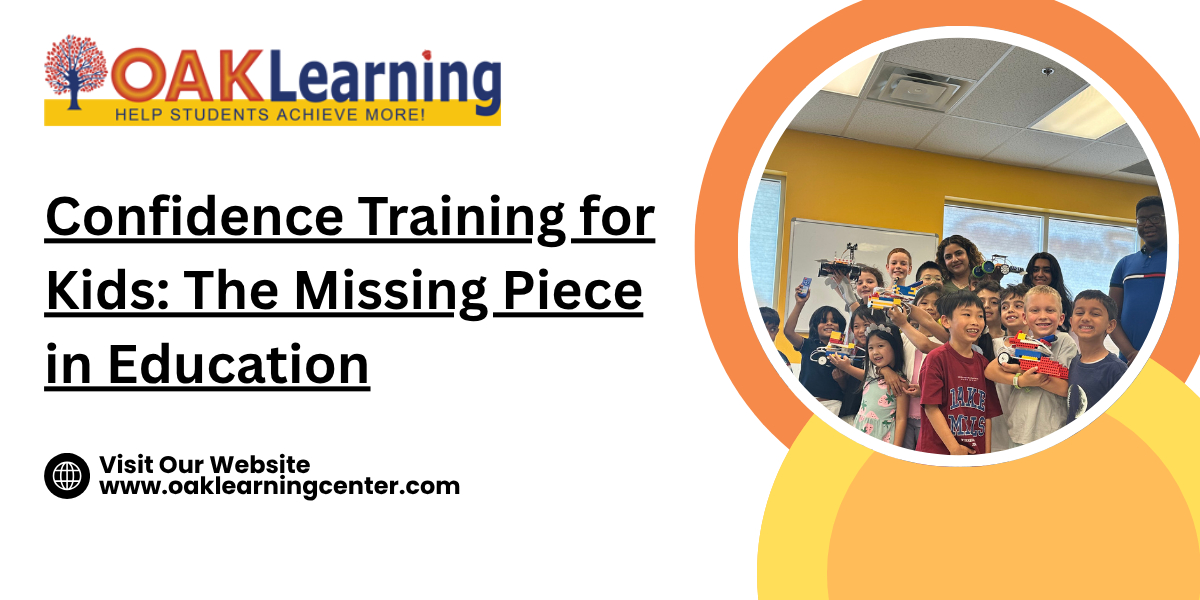
Confidence Training for Kids: The Missing Piece in Education

By OakLearning Center | Updated October 2025
Why Confidence Matters More Than Ever
Every parent dreams of seeing their child walk into a classroom—or life—with confidence. But in today’s education system, something crucial often goes missing: structured confidence training for kids. Schools focus heavily on academics, yet the ability to express, lead, and bounce back from setbacks is what truly prepares children for the future.
That’s where Kids Self Development Programs play a vital role. These programs go beyond grades, nurturing the emotional intelligence and resilience that form the foundation of lifelong success.
The Confidence Gap in Modern Education
While math and science are essential, so is the confidence to communicate ideas, face challenges, and try again after failure. Studies show that nearly 70% of students experience self-doubt during their school years. This lack of confidence often translates into poor participation, reduced motivation, and missed opportunities—both academically and socially.
Many educators agree that while the curriculum teaches “what” to learn, it rarely teaches “how” to believe in oneself. Confidence is not a natural trait—it’s a skill that can be developed with the right guidance and consistent practice. And yet, most schools lack structured frameworks to teach it.
“Confidence isn’t just believing you can win—it’s believing you can grow, even when you lose.”
This is where specialized Kids Self Development Programs step in, filling the emotional and behavioral gaps that traditional classrooms often overlook.
A Parent’s Perspective: More Than Just Grades
When Priya, a mother from Oakville, enrolled her 10-year-old daughter Anaya in a self-development class, she wasn’t sure what to expect. Anaya was bright but often shy, hesitant to speak in groups. After a few weeks of confidence-building sessions, Priya noticed small yet meaningful changes. Anaya began raising her hand in class, sharing her ideas, and even volunteering for school projects.
“I realized,” Priya shares, “that confidence isn’t taught—it’s built. And the best part is, kids don’t even realize they’re learning it; they just grow through experience.”
This story mirrors many parents’ experiences. Confidence grows through small victories, guided conversations, and the encouragement to express oneself freely.
5 Ways to Help Your Child Build Confidence Every Day
-
Let Them Try, Fail, and Try Again
Shielding kids from mistakes can harm their growth. Encourage them to take risks—whether it’s speaking in front of a class or learning a new skill. Each small success fuels belief in their abilities. -
Focus on Effort, Not Outcome
Praise persistence and improvement instead of perfection. Confidence comes from realizing that progress matters more than results. -
Encourage Self-Expression
Give your child space to share opinions at home. Family discussions help them build the courage to express themselves confidently in larger groups. -
Teach Goal-Setting Early
Help kids set small, achievable goals. Each completed goal adds to their self-belief, showing them that effort leads to achievement. -
Model Confidence Yourself
Kids learn by watching. Demonstrate positive self-talk and a growth mindset. Your attitude toward challenges will shape theirs.
Structured Learning: How Confidence Can Be Taught
Confidence doesn’t magically appear—it’s nurtured through guided experiences. The OakLearning Center’s IPath Program is designed on this very philosophy: confidence is a skill that can be acquired.
Through interactive sessions, group activities, and real-life problem-solving, students learn to:
- Communicate effectively and clearly
- Overcome fear of failure and develop resilience
- Collaborate with peers in a supportive environment
- Develop leadership qualities and emotional balance
These experiences are integrated naturally into their learning journey. The focus isn’t just on speaking louder—it’s about thinking clearly, acting confidently, and responding mindfully.
Parents in Oakville often pair these sessions with the After School Program for a holistic balance of academics, creativity, and emotional growth.
What Teachers See: Confidence Changes Everything
Educators often share that confident students don’t just perform better—they engage better. They ask questions, take initiative, and even help peers. One OakLearning mentor noted, “When students believe their voice matters, their learning becomes self-driven.”
Confidence training builds the bridge between knowledge and expression. It helps children not only understand what they learn but also communicate it with clarity and conviction.
What Research Says About Confidence and Performance
According to studies by the American Psychological Association (APA), students with higher self-efficacy are 40% more likely to perform better academically. Confidence impacts not just grades but also emotional well-being and decision-making skills.
Additionally, a Harvard Graduate School of Education report found that students who participate in structured self-development or leadership programs are more adaptable, socially aware, and mentally prepared for future challenges.
In essence, confidence isn’t just a “nice-to-have” quality—it’s a necessity for success in school, work, and life.
Frequently Asked Questions
1. Can confidence really be taught?
Absolutely. Confidence training is about structured exposure and guided learning. Programs like OakLearning Center’s IPath show that with consistent encouragement and mentorship, every child can learn to believe in themselves.
2. What age is best to start confidence training?
The earlier, the better. Kids between ages 6–12 are at a crucial stage for shaping self-esteem and communication habits. Introducing Kids Self Development Programs at this age helps build lasting inner strength.
3. Is it only for shy children?
No. Even outgoing kids benefit from confidence training—it helps channel their energy positively, improves focus, and teaches emotional regulation.
4. How do parents support confidence-building at home?
Encourage open communication, celebrate effort, and provide environments where children can make small decisions independently. Pairing home support with professional guidance amplifies growth.
Help Your Child Grow Confidently
Confidence isn’t a gift—it’s a skill. With the right guidance, your child can learn to speak up, stand tall, and take on challenges with courage. At OakLearning Center, programs like IPath and the After School Program help children build that foundation—step by step, with care and support.
Let’s raise a generation of confident thinkers, communicators, and dreamers—starting today.