
After a full school day, “finish all your homework” can feel like an instruction with no clear starting point. Parents may respond by repeating reminders, while students spend their energy deciding what to do first. A small, predictable routine can make the beginning of the session easier.
The routine does not require a complicated planning app. Paper, the day’s materials and a simple timer are enough. ClockFresh is one browser-based option for setting a countdown without creating an account. Choosing the task and deciding when support is needed remain the student’s and adult’s responsibility.
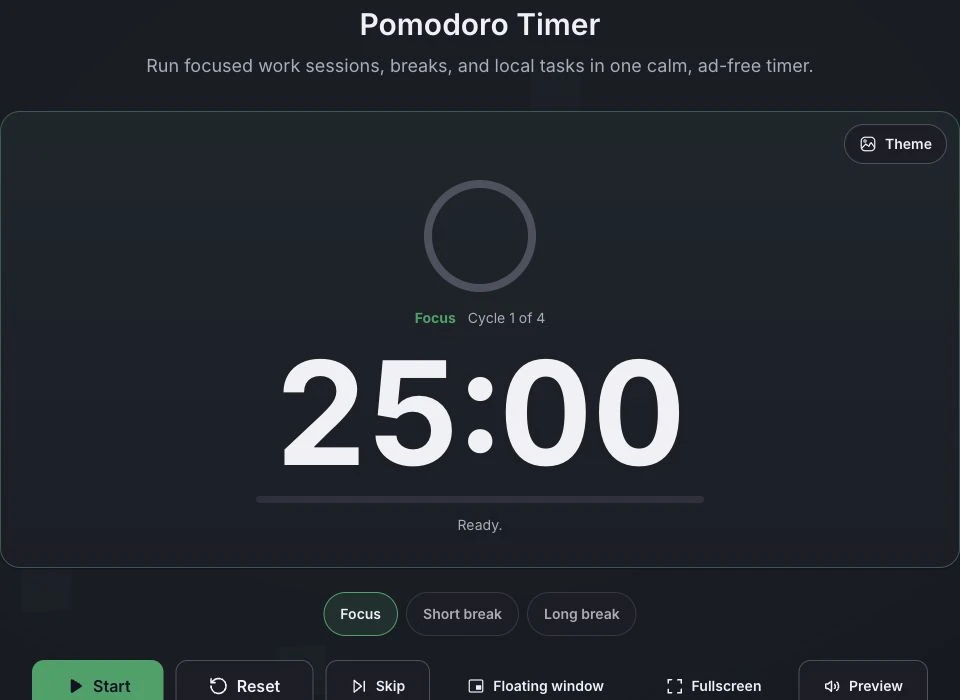
ClockFresh interface screenshot: work and break controls for a flexible study routine. Image supplied by ClockFresh.
Start with a check-in, not a countdown
Before beginning, ask what is due, what materials are available and which part looks difficult. A student who does not understand the instructions needs clarification before being asked to work faster.
Write down the assignments and choose a first action small enough to begin immediately. “Open the workbook and solve question one” is clearer than “do maths.” For a writing assignment, the first action might be listing three ideas rather than completing the entire draft.
Leave room for food, rest and family commitments. The same start time will not suit every student or every day.
Choose a work block together
A short initial block can make a large assignment feel more approachable. Agree on both the task and the stopping point. The student might attempt a few problems, read a passage and write questions, or prepare an outline.
A Pomodoro timer with adjustable work and break settings can support this arrangement. Its familiar 25-minute focus setting is an option, not a requirement. A younger learner may need a shorter activity, and an older learner may prefer to finish a coherent section before taking a break.
Use the duration as a planning choice. Do not present it as a test of attention or a promise that homework will be completed within that time.
Decide what happens when the student gets stuck
Agree on a simple sequence: reread the instruction, look at a relevant worked example, then mark the exact point that is unclear. If appropriate, attempt another question that uses a familiar method.
Set a reasonable boundary on struggling alone. Repeating the same unsuccessful step for an entire block is not the purpose of independent study. A parent can help identify the question without supplying the answer, and a tutor or teacher can address the underlying concept.
A useful request for help is specific: “I know how to expand the brackets, but I do not know what to do with the negative sign.” Keep that note beside the attempted work.
Make the break a real change of activity
Agree in advance on a break that is easy to end: getting water, stretching or stepping away from the desk. A short break can become much longer when it starts an activity with no natural stopping point.
Avoid treating a break as a reward that disappears whenever the worksheet is difficult. The routine should be flexible enough to respond to the day’s workload and the student’s needs. If a timer alert is upsetting or distracting, use a quiet visual cue or let the adult track the time privately.
Review work before adding another block
When the block ends, ask the student to show what they completed and explain one step. Check whether they need more practice, an explanation or a different task. Finishing three understood problems can be more useful than filling a page with a method the student cannot explain.
Do not use the number of completed timer sessions as the only measure of a productive afternoon. Look at the work, the questions and the student’s ability to begin the next step.
End by preparing tomorrow’s first action
Put completed work where it needs to go, note anything to ask the teacher and set aside the materials needed next. A two-line plan can remove a surprising amount of uncertainty from the next session.
If homework regularly takes much longer than expected or repeatedly produces distress, discuss the pattern with the teacher or tutor. Changing the timer setting may help organise the evening, but it cannot resolve every learning difficulty.
The aim is a routine that supports increasing independence: a clear start, manageable work, an agreed route to help and a finish that prepares the next day.